
Relative Clauses Explained: Defining, Non-Defining & Reduced
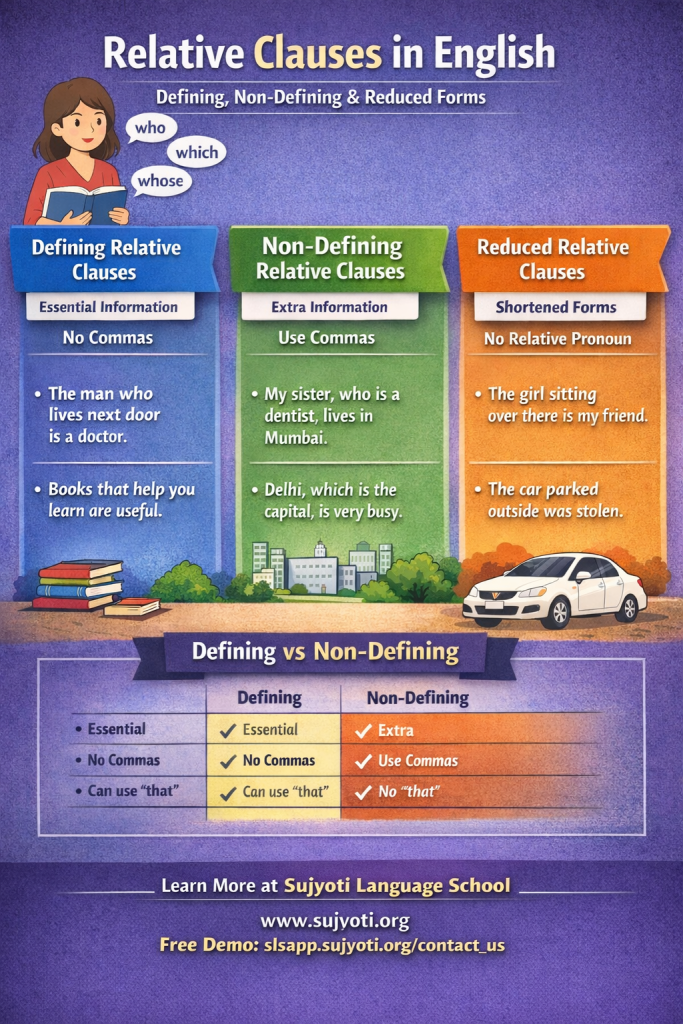
Relative clauses help us add extra information to a sentence without starting a new one.
They make your English clearer, more natural, and more advanced—especially in writing and formal speaking.
In this complete guide, you’ll learn:
✔ Defining relative clauses
✔ Non-defining relative clauses
✔ Reduced relative clauses (advanced usage)
📘 What Is a Relative Clause?
A relative clause gives more information about a noun and usually starts with a relative pronoun like:
who, whom, whose, which, that, where, when
Example:
- She is the teacher who teaches me English.
The clause “who teaches me English” describes the teacher.
1️⃣ Defining Relative Clauses (Essential Information)
Defining relative clauses give essential information.
Without them, the sentence would be unclear.
👉 No commas are used.
🔹 Common Relative Pronouns:
- who / that → people
- which / that → things
- where → places
- when → time
✅ Examples:
- This is the student who topped the exam.
- I like books that help me learn English.
- This is the place where I studied English.
❌ This is the student. (Which student? ❓)
2️⃣ Non-Defining Relative Clauses (Extra Information)
Non-defining relative clauses give extra, non-essential information.
The sentence still makes sense without them.
👉 Commas are always used.
👉 “That” is NOT used.
🔹 Common Relative Pronouns:
- who → people
- which → things
- whose → possession
✅ Examples:
- My teacher, who is very patient, explains clearly.
- Kolkata, which is a busy city, has rich culture.
- She met Priya, whose English is excellent.
💡 Removing the clause doesn’t change the main meaning.
⚠️ Key Difference: Defining vs Non-Defining
| Feature | Defining | Non-Defining |
|---|---|---|
| Information | Essential | Extra |
| Commas | ❌ No | ✅ Yes |
| Use of “that” | ✅ Allowed | ❌ Not allowed |
| Meaning changes if removed | ✅ Yes | ❌ No |
3️⃣ Reduced Relative Clauses (Advanced & Natural English)
Reduced relative clauses are used to make sentences shorter and more natural, especially in writing.
They are formed by removing the relative pronoun and verb.
🔹 Reducing Active Relative Clauses
Full form:
- The boy who is playing outside is my brother.
Reduced form:
- The boy playing outside is my brother.
🔹 Reducing Passive Relative Clauses
Full form:
- The book which was written by him is famous.
Reduced form:
- The book written by him is famous.
🔹 Using Past Participles
- Students selected for the course will receive certificates.
- The work completed yesterday was excellent.
💡 Reduced forms are common in academic and professional English.
🚫 When NOT to Reduce Relative Clauses
❌ If the clause has a modal or tense meaning
❌ If it causes confusion
Example (Do NOT reduce):
- The man who will speak today is my mentor.
📝 Quick Practice
Rewrite using correct relative clauses:
- This is the girl. She won the competition.
- My uncle lives in Delhi. He is a doctor.
- The students who are waiting outside are late.
- The movie which was directed by Nolan was amazing.
✅ Answers:
- This is the girl who won the competition.
- My uncle, who is a doctor, lives in Delhi.
- The students waiting outside are late.
- The movie directed by Nolan was amazing.
🎯 Learn Advanced Grammar with Sujyoti
At Sujyoti Language School, we help learners master grammar from A1 to C2, including advanced structures like:
- Relative clauses
- Nominalisation
- Inversion
- Mixed conditionals
- Academic writing & speaking
👉 Want to speak and write confidently?
Book your Free Demo Class here:
👉 https://slsapp.sujyoti.org/contact_us
